An Unused Value Gets a Gradient: MLX Masked Assignment
Permanent archive: Zenodo · 10.5281/zenodo.22694399.
The forward operation reads each example separately. Its reverse derivative crosses a batch boundary.

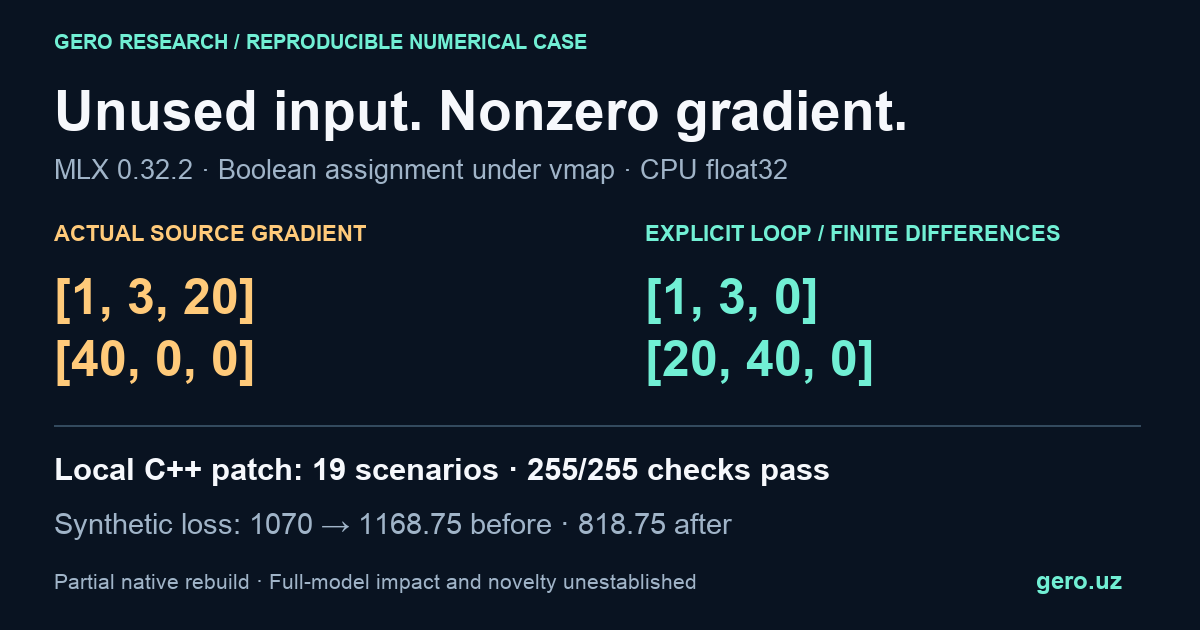
An input that the forward operation never reads should have zero derivative. In this MLX example, an unused source value receives a gradient of 20. Boolean assignment inside vmap produces the correct forward values but mixes source-gradient positions between batch examples.
The official MLX 0.32.2 Python wheel and a partial native C++ rebuild were rerun for publication. An explicit per-example loop, independent algebra and coordinate finite differences of the actual forward agree on the expected derivative. The evidence package contains exact inputs, source pins, executable tests, a proposed patch and actual execution logs.
The 55-second explanation
Watch the English Short on YouTube →
Original diagrams and synthetic narration by the fictional Alex Vector using the macOS Daniel voice. AI-assisted preparation. Remotion project, narration and source ledger →
Two examples, two unused values
destination = zeros((2, 4))
mask = [[True, False, True, False],
        [False, True, False, True]]
source = [[10, 20, 99],
          [30, 40, 88]]
cotangent = [[1, 2, 3, 4],
             [10, 20, 30, 40]]

forward = [[10, 0, 20, 0], [0, 30, 0, 40]]
expected source gradient = [[1, 3, 0], [20, 40, 0]]
actual source gradient   = [[1, 3, 20], [40, 0, 0]]
Each row consumes two values from its own three-element source. Values 99 and 88 are unused. These are valid inputs: the documented assignment contract permits an update source with at least as many elements as the mask selects.
For the fixed mask, the weighted loss is the linear function L = s₀₀ + 3s₀₁ + 20s₁₀ + 40s₁₁. Its derivative is exactly [1,3,0,20,40,0]. Central differences with step 1/256 reproduce this derivative. There is no nondifferentiable selection boundary because the mask is fixed.
The forward/reverse adjoint identity also fails. A perturbation of the unused value s₀₂ has zero forward directional derivative, but the returned reverse gradient has inner product 20 with the same perturbation: 0 ≠ 20.
A measured step goes in the wrong direction
A separate synthetic linear-loss experiment changes the cotangent at position [1,1] to −20. The initial loss is 1070. Its correct derivative is g=[1,3,0,−20,40,0]; the original implementation returns h=[1,3,−20,40,0,0].
step size = 1/8
g · h = -790       g · g = 2010
L(source - h/8) = 1070 + 790/8  = 1168.75
L(source - g/8) = 1070 - 2010/8 = 818.75
The test evaluates the actual forward again after both updates; the observed losses match these algebraic results. This is a small synthetic linear objective. It does not establish a training failure in a complete model.
A global counter replaces a per-example counter
In the inspected MaskedScatter::vjp, flattening the whole mask and applying one cumulative sum loses the separation between examples. Let b be the batch row, K its source length, and p the zero-based ordinal of a true entry within that row. The source address must be b × K + p. The original derivative instead uses the total number of true entries in all preceding rows, plus p.
Those addresses agree when all preceding source rows are fully consumed. They diverge when a row has unused source values. Forward execution starts each row from that row’s own source; backward must use the same boundaries.
The proposed C++ repair forms a prefix count within each batch row and adds the row’s source offset. It uses 64-bit index arithmetic, masks false positions and handles empty inputs before division. It changes the reverse derivative only; forward, JVP and vmap implementations remain unchanged. Runtime and memory performance have not been benchmarked.
Actual validation results
| Check | Original | Patched |
|---|---|---|
| Native scenarios passed | 8/19 | 19/19 |
| Native checks passed | 183/255 | 255/255 |
| Unused source element derivative | 20 | 0 |
| Synthetic loss after step | 1168.75 | 818.75 |
The official Python wheel reproduction was also repeated. The 72 failed checks describe manifestations of one implementation defect; they are not 72 separate findings. Passing this targeted suite is not proof of correctness over every possible state.
Version pins and reproduction boundary
- Inspected main:
24c699ecee2f7c8b2040de8da1c8382c8bcf31c7. - Compatible native base:
ce916dbbcaa88e433b6fd1e60a17f766d49c27fe. Six related functions were re-extracted and confirmed identical to the inspected main. - Apple clang 17.0.0, C++20, macOS arm64, CPU float32. Original and patched translation units were linked ahead of a reused CPU-only MLX archive.
- All 31 supplied artifact hashes matched. Publication verification then repeated the wheel probe, native compilation and native before/after executions.
Native validation is a partial rebuild on a compatible base, not a clean full build of current main. The public build instructions preserve this distinction and list the required source and archive hashes.
python3 -m venv .venv
.venv/bin/pip install -r requirements.txt
.venv/bin/python probe.py

export MLX_SOURCE_ROOT=/absolute/path/to/mlx-at-ce916db
export MLX_CPU_BUILD=/absolute/path/to/cpu-build
python3 build_and_test.py
Complete build instructions · C++ harness · Original log · Patched log.
Prior work and limitations
The original implementation contains the global-counter pattern. Earlier work includes shape handling, a flaky vmap test and a different JVP correction. The limited search did not establish whether this exact reverse-derivative defect has already been reported. Novelty and maintainer acceptance remain unestablished.
GPU, compiled execution paths, other dtypes, every shape and full-model effects were not tested. No device harm, security impact or reward eligibility is asserted. Included MLX source retains its MIT license.
Prepared with AI assistance. Evidence consists of actual execution, independent algebra and finite differences. This is independent GERO Research work, without Apple endorsement.
Full English report, tests and patch →
Download the evidence ZIPSHA-256: 1449d82f1b1ba6ad69c7c6c4e8156ff7c7d03900d35c4be7554c94fe6baa351f
Source ledger · File checksums
#MLX #Autodiff #MachineLearning #NumericalComputing #SoftwareTesting