A Nonzero Derivative Becomes Zero: MLX expm1
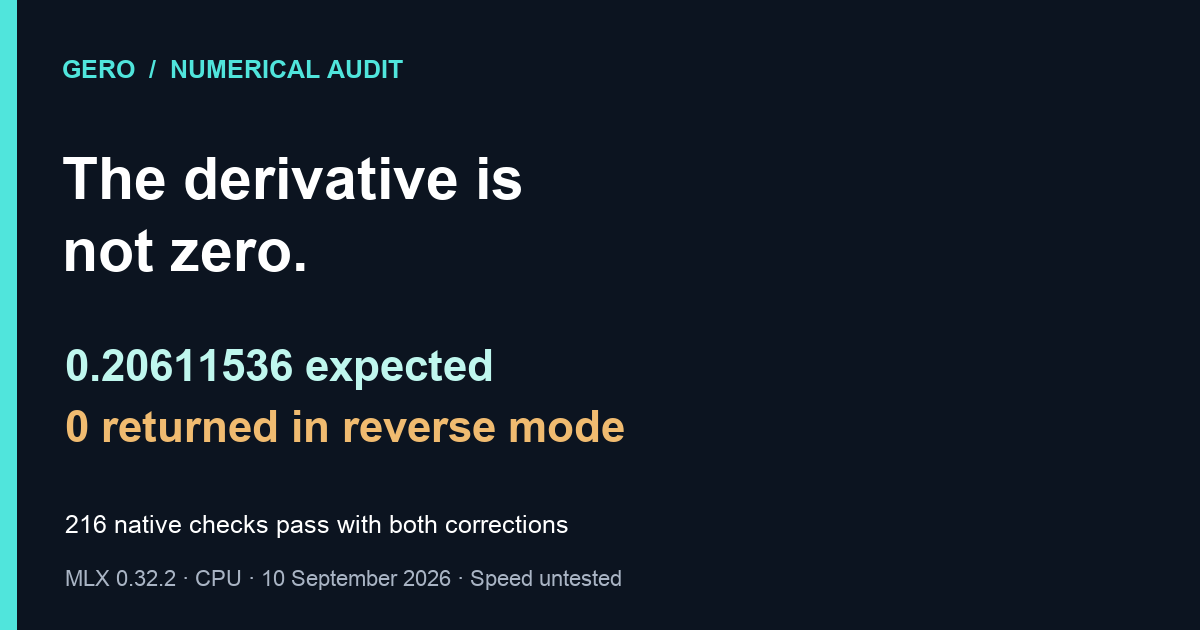
At x=-20, reverse mode returns zero for a derivative near 0.20611536. A local VJP repair plus the known exp control passes 216 native comparisons; the VJP-only patch can regress float64.

Permanent evidence archive: 10.5281/zenodo.22685337 · Zenodo, version 1.0.0.
A one-minute explanation
Synthetic narration by fictional Alex Vector using macOS Samantha. Original evidence diagrams, with source ledger, script and renderer. AI-assisted preparation.
For f(x)=1e8*expm1(x) at float32 x=-20, the mathematical derivative is 0.2061153622. The tested MLX forward mode returns 0.2061153501, while reverse mode returns 0. A local VJP repair combined with a control for the already reported float64-exp defect passes 216 native comparisons, including second and third derivatives.
The VJP patch alone is not a complete float64 repair: the existing CPU exp defect can turn a previously finite derivative at x=100 into infinity. Both changes and four control variants are included. No performance qualification or upstream acceptance is claimed.
Detailed Russian report · Build instructions · Python reproduction · C++ regression · VJP patch
Reproduce the failure
import mlx.core as mx
mx.set_default_device(mx.cpu)
x = mx.array(-20., dtype=mx.float32)
f = lambda z: 1e8 * mx.expm1(z)
print(mx.grad(f)(x))                            # 0
print(mx.jvp(f, [x], [mx.ones_like(x)])[1][0])   # ~0.20611535
Run python3 probe.py with MLX 0.32.2 installed. It limits numerical threads to one and selects CPU. The wheel may initialize Metal at import; the arithmetic is explicitly on CPU. The native archive has no Metal backend.
| Input | dtype | Forward expm1 | JVP, direction 1 | VJP, cotangent 1 | Analytic derivative |
|---|---|---|---|---|---|
| -20 | float32 | -1 | 2.06115347e-9 | 0 | 2.06115362e-9 |
| -18 | float32 | -1 | 1.52299915e-8 | 0 | 1.52299797e-8 |
| -10 | float32 | -0.9999545813 | 4.53999310e-5 | 4.54187393e-5 | 4.53999298e-5 |
| -40 | float64 | -1 | 4.24835372e-18 | 0 | 4.24835426e-18 |
The expected derivatives are normal representable values, so derivative underflow does not explain the zeros. The reference is the analytic derivative exp(x), numerically evaluated with Python math.exp and C++ std::exp in double. The real MLX JVP provides a separate control. Wheel measurements.
Finite differences of the rounded float32 forward output near -20 are not used as a reference: that output is already -1 at neighboring points. This report concerns the derivative of the mathematical operation used by autodiff.
Cause and repair dependency
The pinned Expm1::vjp multiplies the incoming cotangent by outputs[0] + 1. Once expm1(x) rounds to -1, the derivative vanishes. Relative accuracy is also lost before complete saturation. Expm1::jvp instead computes exp(primals[0]) directly.
The VJP patch uses that same direct exp formula. It eliminates the tested float32 mismatches, but exposes the separate CPU double-exp precision/range problem already described in MLX #3047. At float64 x=100, the original VJP is finite while a VJP-only replacement using the defective exp returns infinity. At x=-1, it loses double precision.
The included exp control uses scalar libm to isolate correctness. It is reused known work, not a new discovery. Neither its speed nor the added exp evaluation in VJP has been benchmarked.
| Native variant | Comparisons | float32 mismatches | float64 mismatches | Total |
|---|---|---|---|---|
| Original VJP and exp | 216 | 25 | 67 | 92 |
| VJP repair only | 216 | 0 | 87 | 87 |
| Exp control only | 216 | 25 | 28 | 53 |
| VJP repair + exp control | 216 | 0 | 0 | 0 |
Before · VJP only · Exp only · Combined. These are comparisons, not distinct defects. Existing float64 JVP errors belong to the known exp dependency.
The native suite calls actual MLX primitives. It covers float32/float64 scalar points from -80 to 20, directions 0/1/-0.5/2, extra double points -700/-100/100/700, second and third reverse derivatives at -40/-20/-10/0/1, a 2×3 matrix, noncontiguous input, mixed weights and scalar broadcasting. Relative tolerances are 4e-6 for float32 and 2e-14 for float64; expected zeros require exact zero. There is no large absolute tolerance that would hide missing small derivatives. Reference inputs are rounded to their actual dtype first.
Public history and scope
No matching MLX negative-tail VJP report was found in the recorded public search. Its six broad expm1 results were #1277 (forward Metal behavior), #1281 (older tolerances/build), #973 (operation addition), #3080 (arm64 CPU JIT/Float16 compilation), #4257 (complex rejection) and #4227 (analytic gradient tests, with no defects reported in its chosen series). Search evidence.
An analogous reverse-mode expm1 failure was already reported for JAX in JAX #39794, opened 6 August 2026. This package does not rerun JAX and does not claim a globally new mechanism. The bounded MLX search does not prove absolute priority.
The wheel is 0.32.2; native baseline is ce916dbbcaa88e433b6fd1e60a17f766d49c27fe; reviewed public main is 81ba1c6a0e50a9268b931579c2d4f1158b9aab5a. Complete Expm1::vjp and Expm1::jvp methods match between baseline and saved main. Source hashes · Native provenance.
Validation uses isolated primitives.cpp and unary.cpp overrides before a pre-existing CPU archive; it is not a complete current-main build. CPU float32/float64 were tested. GPU, float16/bfloat16, compile, vmap, NaN/±inf, model-level effects and performance were not. Complex expm1 is unsupported and excluded. The finite suite does not establish arbitrary-order autodiff correctness.
Numerical work was sequential with one numerical thread and no GPU computation. Publication rerun evidence, artifact verification, source code and hashes are included; compiled binaries and unfinished scouts are excluded. AI assisted investigation, code and publication preparation. This is an independent author repository report, not an upstream MLX submission.
Versioned evidence
GitHub report, source and patch · Evidence ZIP
ZIP SHA-256: f72a5f7ba76f48a28ca3b3ebcb030a69aa3e387cd5f85fb80689b813e1700395
License: report text and original diagrams CC BY 4.0; code and derivative MLX patches MIT. See the package for notices.