One FP16 Batch Corrupts MLX BatchNorm Running Variance
Permanent archive: Zenodo · 10.5281/zenodo.22695450.
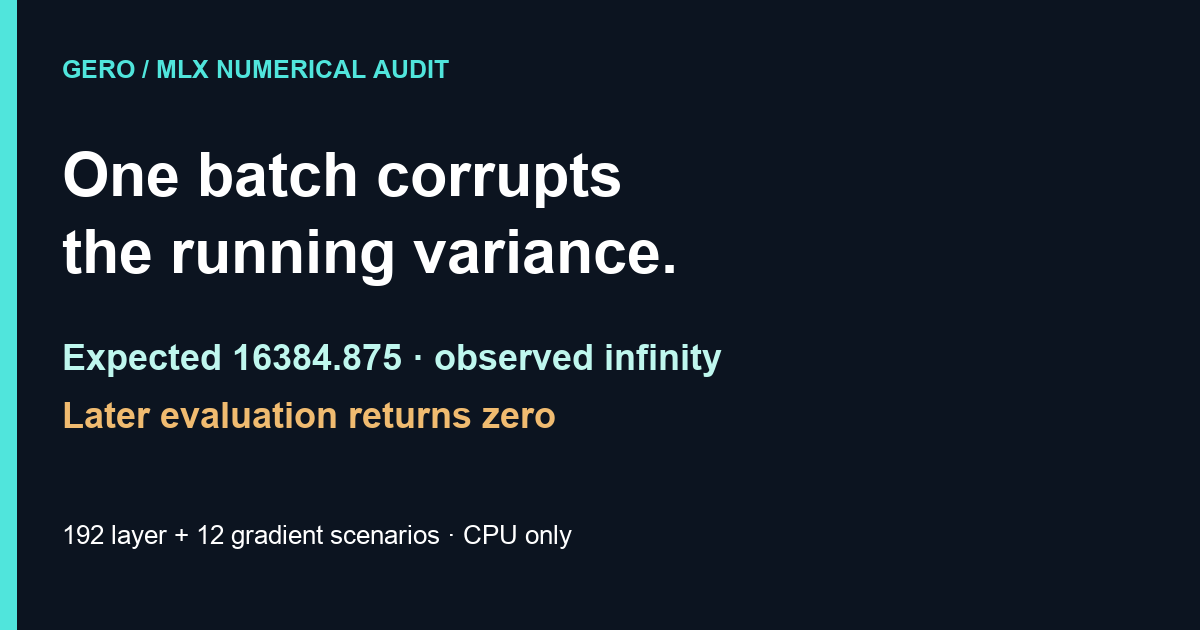
A finite float16 batch makes the default running variance infinite, leaving later evaluation at zero. A CPU research patch changes 102 main-suite failures to zero, with 33 compatibility checks passing. Existing corrupted state is not restored.

A one-minute explanation
Watch on YouTube · Read in the Hugging Face corpus
Synthetic narration by fictional Alex Vector using macOS Samantha. Original diagrams; source ledger, script and renderer. AI-assisted preparation.
Independent numerical audit by Xamit Kadirbekov, 10 September 2026. Recorded on Apple MLX 0.32.2, CPU. A finite float16 batch can make BatchNorm's default float32 running variance infinite. Later small training batches do not restore that state; evaluation then produces zeros.
import mlx.core as mx
import mlx.nn as nn
mx.set_default_device(mx.cpu)
bn = nn.BatchNorm(1, momentum=0.125, affine=False)
x = mx.array([[-256.], [256.]], dtype=mx.float16)
print(bn(x).tolist())             # observed: [[-0.0], [0.0]]
print(bn.running_var.tolist())   # observed: [inf]
small = mx.array([[-1.], [1.]], dtype=mx.float16)
bn(small)
print(bn.running_var.tolist())   # still [inf]
bn.eval()
print(bn(small).tolist())        # observed: [[-0.0], [0.0]]
The correctly evaluated first training output is approximately [-1, 1]. With the stated momentum, running variance should become 16384.875, then 14337.015625 after the small batch. Evaluation on that small batch should produce approximately [-0.008351618, 0.008351618]. These before/after values are preserved in the momentum/0.125/* entries of compatibility-results.json.
The candidate prevents new corruption in the tested range. It does not repair statistics that are already infinite. No full-model quality loss, checkpoint recovery, security exploit or financial damage is claimed.
Evidence and reproduction
- Original Russian audit, retained with its original pre-publication status.
- Probe and installed-wheel results.
- Seven-line research patch, patched module, and patch construction.
- Main results, compatibility results, and variance-boundary results.
- Portable instructions, original checksums, and publication artifact verification.
The original files are preserved byte for byte under evidence/. Publication preparation checked their hashes, result counts and patch application without rerunning numerical experiments. The recorded numerical scripts explicitly use CPU, set numerical thread limits to one, and run sequentially. Their source modules execute on the installed MLX 0.32.2 binary runtime; this is not a complete build of current main.
Mechanism
The pinned BatchNorm implementation computes mean and variance in the input dtype. Conversion during the later running-state update cannot recover a value already lost to overflow.
For inputs [-C, C], the training variance is C² and the unbiased estimate used for running variance is 2C². With C = 256, these are 65536 and 131072. They exceed float16's finite range, even though the intended float32 state update is finite:
v1 = (1 - 1/8) * 1 + (1/8) * 131072 = 16384.875The next finite batch multiplies the corrupted state by 7/8, retaining infinity. Small-batch training output can look normal again because training uses its current batch statistics. That does not establish recovery of the stored state used by evaluation.
The boundary case [-192, 192] fails even though its true training variance 36864 fits float16. The reduction adds two squares before division, so 36864 + 36864 overflows first. The recorded boundary experiment and pinned variance source document this order of operations.
Candidate repair and compatibility policy
The candidate promotes float16/bfloat16 input to float32 before calculating mean and variance. Normalization uses those statistics; in training or without running-stat tracking, its result is cast back to the original low-precision dtype before affine parameters are applied.
The separate biased/unbiased estimators, momentum formula, batch-size validation and frozen-parameter status remain. Float32/float64 arithmetic is unchanged. Evaluation with stored statistics preserves the original dtype promotion, including float32 output for float16 input with default float32 buffers.
If a user has explicitly converted the state buffers to float16 or bfloat16, the next training call promotes those buffers to float32. This is an intentional compatibility choice that needs maintainer review. Four additional post-patch checks cover it.
Recorded results
| Suite | Checks before / after | Failures before | Failures after |
|---|---|---|---|
| 192 forward/state/eval scenarios and 12 gradient scenarios | 2760 / 2760 | 102 | 0 |
| Compatibility and parameter boundaries | 29 / 33 | 18 | 0 |
| Representable-variance boundary | 5 / 5 | 4 | 0 |
The main suite's 2760 assertions include 1020 numerical comparisons. Other assertions check dtypes, shapes, unchanged inputs, evaluation state and the absence of gradients for frozen statistics. They are not 2760 independent batches. The 102 baseline failures comprise 68 outputs, 24 running variances, four running means, two gamma gradients, two input gradients and two state updates during value-and-grad. There are 86 float16 and 16 bfloat16 failures; some are accuracy errors rather than overflow.
The reference uses 60-digit scalar Decimal arithmetic on the already quantized inputs and analytical BatchNorm derivatives, with rounding matched to output and parameter dtypes. Tests cover NC, NLC and NHWC shapes; four real dtypes; multiple scales; affine and tracking modes; train-to-eval transitions; and nonuniform gamma/beta. Gradient checks include real nn.value_and_grad calls.
Compatibility checks include the exact public test_batch_norm and test_batch_norm_stats methods, several momenta, small positive epsilon, invalid shapes, and save/load of small local NPZ checkpoints. The PyTorch-parity method was not run. Recorded process CPU times are test durations, not layer benchmarks.
Prior work and limits
The original bounded search examined 26 distinct issues/PRs and 31 comments. PR #3817 fixes the running-variance estimator and singleton batches; that fix is already present in the audited source. Issue #1960 concerns when state updates occur during value-and-grad. The state here does update, but receives infinity. Issue #4228 documents related float16 overflow in InstanceNorm. This report establishes a BatchNorm counterexample and persistence into running state and evaluation. No exact duplicate was identified in the examined material; absolute novelty is not claimed.
At inputs around 2**80, variance can exceed even float32. The candidate still produces zeros/infinity in the preserved float32/bfloat16 remaining_limits examples. Promoting bfloat16 to float32 does not solve that range problem. Standalone mx.mean/mx.var, GroupNorm, and other normalization layers are not repaired by this patch.
GPU, compiled execution, distributed training, full-model training and large-array performance were not tested. Already corrupted statistics are not restored. The original harness correction and an initially incorrect hypothesis about the [-192,192] boundary are retained in the archive.
Independent, AI-assisted research and publication preparation. This is a candidate patch for review, with no claim of upstream acceptance or production readiness. Licenses.
Versioned evidence
GitHub report, code and patch · Evidence ZIP
ZIP SHA-256: b1bc7d350aa734997fc760b6a51d12b14fefb2d0fe1b29a0b699d6eb3af8f9f4